Online cheap cigarettes
Cheap
cigarettes store
The brand integrity department, cheap cigarettes online store which Philip
Morris USA just established last year, is a command center for one of
the major fronts in the company's campaign to hold onto its dominance
of the U.S. cigarette market.
This is where about 30 people - drawn from various departments cheap cigarettes online store within
the company - collect intelligence and spearhead the fight against what
the company says is a growing trend of rip-offs and illegal sales of
its cigarette brands.
Heading the unit is John E. "Jack" Holleran, who sums up its mission
with a statement that sounds almost like something that would come from
a military counterintelligence officer.
"Our goal is to disrupt, reduce and eliminate
all this illegal activity," said cheap cigarettes online store Holleran, a lawyer who was named vice
president of brand integrity last summer after seven years with the
company.
The "illegal activity" includes several categories of cigarette
marketing that the cheap cigarettes online store company calls "contraband." It includes:cigarette
sales that don't include required payments to states as part of the
1998 multistate tobacco settlement, and
illegal imports or "gray-market" cigarettes, which are manufactured cheap cigarettes online store for
sale overseas but are shipped back and sold without the company's
permission.
"It's all illegal activity, which is why we are working closely with
law enforcement," Holleran said. "We've spent much of the last year
crime-fighting, and also trying to build up our infrastructure."
In addition, Holleran and other company officials cheap cigarettes online store have been lobbying in
state legislatures for tighter restrictions on cigarette manufacturers
and Internet vendors that the company argues are avoiding taxes and
other required payments to state governments. Virginia recently joined
other states that have passed such legislation backed by Philip Morris.
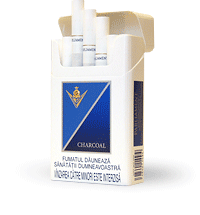
Contraband cigarettes have been around for cheap cigarettes online store about as long as the
government has been taxing tobacco, and counterfeits and smuggling have
long been seen as a simple nuisance in the industry. But the fact that
Philip Morris USA has set up a department for the specific purpose of
rooting it out is a signal that the stakes have become much higher for
the nation's top cigarette company.
Indeed, major cigarette makers like Philip Morris have a lot more cheap cigarettes online store to
worry about than lawsuits filed by sick smokers. They've come under
intense attack by so-called underground manufacturers and cigarette
vendors that are taking advantage of cigarette price increases to grab
customers from the leading players.
Among the chief culprits identified by the company is a tier of small
manufacturers operating here and overseas that have flooded the market
with super- cheap cigarettes.
Philip Morris has fought off attacks by discount brands in the past by
cutting prices, cheap cigarettes online store launching cheaper brands and heavily promoting premium
brands. The company is using a similar strategy this time, but the
circumstances are different.
Cigarette prices have skyrocketed, in part because major U.S. companies
are paying $246 billion to states as part of a 1998 legal settlement,
and also because many states have increased cigarette taxes to help
fill budget gaps. Both developmesnts have made it harder for major
companies to compete in pricing, and their profits have taken a hit.
Altria Group Inc., the New York-based parent company of Philip Morris
USA, reported in January that its fourth-quarter profit fell 18
percent. Its domestic tobacco business reported a 50 percent drop in
operating income to $789 million as the company boosted promotions of
its brands to fight off competition from bargain competitors.
Staying competitive in the tightening U.S. market was the main motive
behind Philip Morris USA's decision, announced this month, to move its
headquarters from New York City to Richmond. The announcement was
greeted as a major economic development victory by local and state
officials, but for Philip Morris USA it was all about bolstering the
bottom line. The company said it expects to save about $60 million a
year by moving out of New York City.
It's not just competition from legitimate discounters that worries
Philip Morris. Counterfeiting is on the increase, as is smuggling, and
the Internet also has become a hotbed of marketing. Hundreds of Web
sites have sprung up to cater to customers who are fed up with high
cigarette prices. That's where the brand integrity department comes
into play. During the past year, Philip Morris USA has initiated an
intense fight to put many of the upstarts out of business before they
can do more damage.
In September, the company filed lawsuits against 13 Internet cigarette
vendors, some operating overseas and some in the United States. The
company claims the sites used its trademarks, without permission, cheap cigarettes online store to
sell illegally imported cigarettes.
Internet sales now account for a little more than 2 percent of total
U.S. cigarette sales, but that
figure could grow to 6 percent in five
years, according to some estimates.
Philip Morris officials say they have never authorized Internet sales
of the company's brands, and the company contends that most of those
sales are illegal.
Internet sellers are typically based overseas, in states with low
cigarette taxes, or on Indian reservations where state taxes do not
apply. Critics say most of these sites have flourished by selling cheap
cigarettes to customers in high-tax states without paying excise taxes.
"The only way you can make money by selling cigarettes on the Internet
is by not paying taxes," Holleran said.
A report released by the U.S. General Accounting Office last year backs
that up. The agency investigated 148 Internet sites and found that none
of them was complying with the Jenkins Act, a 1949 federal law that
requires mail-order cheap cigarettes online store vendors to provide information on shipments of
cigarettes to state taxation authorities.

The GAO report said that Internet sales could cost the cheap cigarettes online store states $1.4
billion in lost tax revenues by 2005.
Philip Morris has also launched a legislative campaign against Internet
sites. The company has lobbied aggressively, and successfully, in
almost every state, including Virginia, for laws that require online
vendors to obtain written proof of a customer's age before they can
sell someone cigarettes, and increasing the penalties for illegal sales.
Philip Morris USA's position on Internet sales is clearly intended to
protect its traditional base of bricks-and-mortar retailers, where the
company enjoys a huge advantage. But the company also says one goal is cheap cigarettes online store
to prevent Internet sites from selling its brands to minors.
"We think cigarette sales should occur in face-to-face transactions
where age can be verified," Holleran said.
Oddly, the company's hostility to Internet vendors has put it somewhat
in a league with anti-tobacco groups, who also think online cigarette
sales should be heavily regulated, if not banned.
But health groups also have argued that the legislation that Philip
Morris backs doesn't go far enough and contains loopholes that could be
used by the company should it decide to enter the Internet business.
Eric Lindblom, manager of policy research for the Campaign for
Tobacco-Free Kids, said the old Jenkins Act model that simply requires
vendors to provide the names of customers to tax agencies is "awkward"
and needs to be reformed.
"It is a leaky bucket. It is a flawed system, and it really subverts
the integrity of the tax collections system," he said.
Tobacco companies have laid much of the blame for the growth in cheap cigarettes online store
contraband cigarettes on state governments' fondness for raising
cigarette taxes.
Twenty states and the District of Columbia increased their cigarette
excise taxes last year, boosting the national average to 65 cents a
pack.
Tommy Payne, a spokesman for R.J. Reynolds Tobacco Co., the nation's
second-largest cigarette maker, said the company hasn't had much of a
problem with brand counterfeiting so far.
But the company, like Philip Morris USA, has lobbied aggressively
against cigarette tax increases, arguing that it will ultimately cost
the states revenue as more smokers turn to cheaper brands, even if
those are illegally sold.
In New York City, for example, where the state and city excise tax is
$3 per pack, the price of premium cigarettes has hit $7 a pack. Cheap,
illegal cigarettes - many of
them smuggled north from Virginia and
North Carolina - have become a hot item on the streets.
Tax increases "are very, very shortsighted from a revenue standpoint,
besides being blatantly unfair to smokers," Payne said. "We have spent
a lot of time trying to defeat excise taxes."
Another target of the industry's legislative campaign are the so-called
nonparticipating manufacturers, small cigarette companies that didn't
join the nation's top tobacco companies in signing the 1998, $206
billion multistate tobacco settlement.
Under the terms of the settlement, the nonparticipating manufacturers
are still required to make escrow payments in the states where they
sell cigarettes, but Philip Morris and other manufacturers argue that
many of the companies are illegally avoiding those payments, which
enables them to sell their brands much cheaper and undercut the majors.
The company is lobbying state legislatures for laws that will close cheap cigarettes online store the
loopholes, and the Virginia General Assembly passed one such bill this
year. The state has gone on the attack. This month, Attorney General
Terry Kilgore filed lawsuits against 10 companies that the state claims
haven't made escrow payments on their cigarette sales here.
Meanwhile, Philip Morris has filed more lawsuits. In October, the
company went to court against 55 retailers the company claims were
selling counterfeit Marlboro
cigarettes. Earlier this month, the
company went to court against 325 other retailers in seven states, also
accusing them of selling counterfeit cigarettes and illegally using the
Marlboro trademark.
The company said it uncovered the counterfeits during periodic auditing
in which representatives purchased cigarettes at various retail
locations.
No one knows for sure exactly how many counterfeit cigarettes are sold
in the United States, "but what we do know is that the problem is
growing," Holleran said.
Agents with the U.S. Bureau of Alcohol, Tobacco and Firearms agree. The
agency has seen an increase in the number of counterfeit cigarettes
shipped into the United States, as well as smuggling from low- to
high-tax states.
"As long as you have a differential between taxes you will have
contraband cigarettes," said Jerry Bowerman, chief of the ATF's alcohol
and tobacco diversion branch.
The problem, he said, "is only getting worse" as cigarette prices rise.
Bowerman said gray-market cigarettes have become much less of a problem
now that most states and Congress have passed legislation prohibiting
the re-importation of cigarettes intended for export markets.
"The largest threat today is really the counterfeit cigarettes that
come into the United States from both coasts," said Carolyn Williams,
chief of the ATF's alcohol and tobacco intelligence branch.
Cigarettes topped the list of counterfeit products confiscated by U.S.
Customs in 2002.
It's no surprise that Marlboro, Philip Morris' top brand and the
world's most popular cigarette, is also the most counterfeited brand in
the world.
Most of the fakes are manufactured overseas, and the largest cheap cigarettes online store source is
probably China, where counterfeiters have set up sophisticated
manufacturing operations, often in caves in rural areas.
The counterfeits are shipped into the United States on ships with
falsified manifests, and "they work their way into the regular supply
chain," Williams said.

"Some of them are really good-quality cigarettes, and the other ones
are like sweepings off the floor," Bowerman said. "I would say that a
normal consumer, by picking up a package of these cigarettes, could not
tell the difference in a domestically produced brand versus a
counterfeit brand."
The suspicious cigarettes stored at Philip Morris USA's brand integrity
office come from various sources. Some come from law enforcement
agencies, others are packs that have been returned to the company.
Holleran said the company conducted about 175 tests of cheap cigarettes online store suspicious
cigarettes last year, and about 75 percent of the cigarettes turned out
to be counterfeit.
There's much about the functioning of the contraband cigarette supply
chain that remains unknown. The company, Holleran said, is working with
law-enforcement agencies to share information and educate officers
about how to detect contraband. The company is also trying to build its
own intelligence database to find better ways to break through the
underground.
"It's old-fashioned detective work," Holleran said. "It's all about
cheap cigarettes online store connecting the dots."
